Most businesses don’t think about domain authority until something starts to feel off. Your site looks good, your services are solid, but your search visibility doesn’t match the effort.
When you’re trying to increase domain authority, it helps to strip the idea down to what these scores actually measure. Most “authority” metrics estimate strength from links and link-related signals, not from design quality or how long you’ve been in business.8
At Local Robot, we treat domain authority as a visibility and trust issue. Mentions and links from reputable sites make it easier for search engines and customers to take your business seriously.
What domain authority is and why the score matters
Domain Authority, often shortened to DA, is a third-party metric. Moz created it, and it predicts ranking ability based on link data and related signals.
Other SEO tools use different names and formulas, so do not treat one score as universal truth. Treat it as a benchmark you compare over time and against competitors.
Most authority metrics heavily weight these link signals
- Backlinks, meaning links from other sites to yours
- Link quality, meaning relevance and trust of the linking site
- Link diversity, meaning links from many unique sites, not just one
Backlinks = Authority
Google has been clear about this. Backlinks help Google to discover pages and to assess relevance.4 Think of backlinks like citations. A solid citation comes from a source people already trust. A weak citation comes from a place nobody reads.
Backlinks that tend to help the most
- Within your niche/industry/local relevance
- Editorial context, where the link exists because you earned it
- Real sites with standards, such as local news, associations, vendors, partners, and clients
Avoid shortcuts. Google calls out buying or selling links for ranking purposes as link spam. That includes exchanges of money, products, or services for links that pass ranking credit.5
Start with profiles on trusted platforms
For local businesses, profiles on well-known platforms often help for two reasons. People use them to vet providers, and search engines use them as entity signals.
Platforms like Yelp and Nextdoor can create consistent brand mentions, customer reviews, and citations. It is also worth knowing that Google treats nofollow, sponsored, and ugc link attributes as hints in its systems, not strict instructions.6
Make profiles count, not just exist
- Use one business name everywhere
- Keep address and phone consistent across listings
- Write a specific service description, not a slogan
- Add current photos
- Link to the most relevant page on your site, often a service page
Consistency matters for local SEO. BrightLocal describes NAP consistency as keeping your name, address, and phone number uniform across citations, and it ties accuracy to local search visibility and trust.2
Use ChatGPT sources to spot listing gaps
This method works best as a gap check, not as a replacement for real competitor research.
A simple way to find repeated directory sources
- Search in ChatGPT for a list of providers in your service category and location.
- Open the Sources list for that response and note the sites it cites.
- Look for directories, roundups, local publications, and association pages that appear more than once.
- Claim or request inclusion on the reputable ones that fit your business.
OpenAI documents that ChatGPT search can provide links to web sources, plus inline citations and a Sources view for cited sites.9
Do not chase every directory. Prioritize relevance and real-world trust.
A handful of solid sources usually beats dozens of low-quality listings.
Check your authority score using more than one tool
Different tools measure different things. Comparing a few helps you avoid overreacting to one score change.
Common tools people use for domain-level authority benchmarks
- Moz Link Explorer
- Ahrefs Website Authority Checker
- Semrush Backlink Analytics
- Majestic Site Explorer
- Ubersuggest
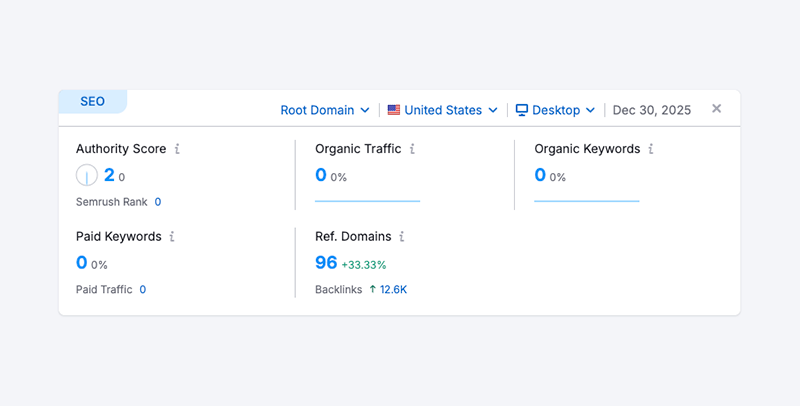
Ahrefs describes Domain Rating as a 100-point measure comparing backlink profile strength within its database.1 Semrush describes Authority Score as a compound metric that includes link signals, plus other factors such as organic traffic and spam indicators.7
When getting help makes sense
Some authority work is straightforward. Some becomes messy fast, especially when old listings, duplicate profiles, and thin backlinks pile up. Local Robot, based in Providence, Rhode Island, helps businesses build a stronger local SEO foundation and a site that earns trust over time.
Contact Local Robot with what you do and where you serve. We will share the highest-impact next steps based on your situation.
References
- Ahrefs. (n.d.). What is Domain Rating (DR)? Ahrefs Help Center. Retrieved March 4, 2026, from https://help.ahrefs.com/en/articles/1409408-what-is-domain-rating-dr
- BrightLocal. (2025, October 10). What is NAP and why is NAP consistency important? Retrieved March 4, 2026, from https://www.brightlocal.com/learn/what-is-nap/
- Google. (2025, December 10). Link best practices for Google. Google Search Central. https://developers.google.com/search/docs/crawling-indexing/links-crawlable
- Google. (2019, September 10). Evolving “nofollow” and new ways to identify the nature of links. Google Search Central Blog. https://developers.google.com/search/blog/2019/09/evolving-nofollow-new-ways-to-identify
- Google. (2025, December 10). Spam policies for Google web search. Google Search Central. https://developers.google.com/search/docs/essentials/spam-policies
- Majestic. (n.d.). Introducing Trust Flow. Retrieved March 4, 2026, from https://majestic.com/trust-flow
- Moz. (n.d.). Guide to Link Explorer linking domains. Moz Help Hub. Retrieved March 4, 2026, from https://moz.rankious.com/_moz/help/link-explorer/link-building/linking-domains
- OpenAI. (n.d.). ChatGPT search. OpenAI Help Center. Retrieved March 4, 2026, from https://help.openai.com/en/articles/9237897-chatgpt-search/
- Schwartz, B. (2019, February 5). Moz upgrades controversial ‘domain authority’ metric. Search Engine Land. https://searchengineland.com/moz-upgrades-controversial-domain-authority-metric-311609
- Semrush. (n.d.). What is Authority Score? Semrush Knowledge Base. Retrieved March 4, 2026, from https://www.semrush.com/kb/747-authority-score-backlink-scores
